
Domainee vs Custom Domain
Domainee and Custom Domain both let SaaS apps connect their customers' custom domains. The interesting differences are in pricing, free tiers, and how much you can do without a sales call.

Domainee
Custom Domains API for SaaS
Custom-domain-as-a-service for SaaS apps. 20 domains and 100 GB bandwidth free forever. Public REST API + MCP server so AI agents can drive it too.
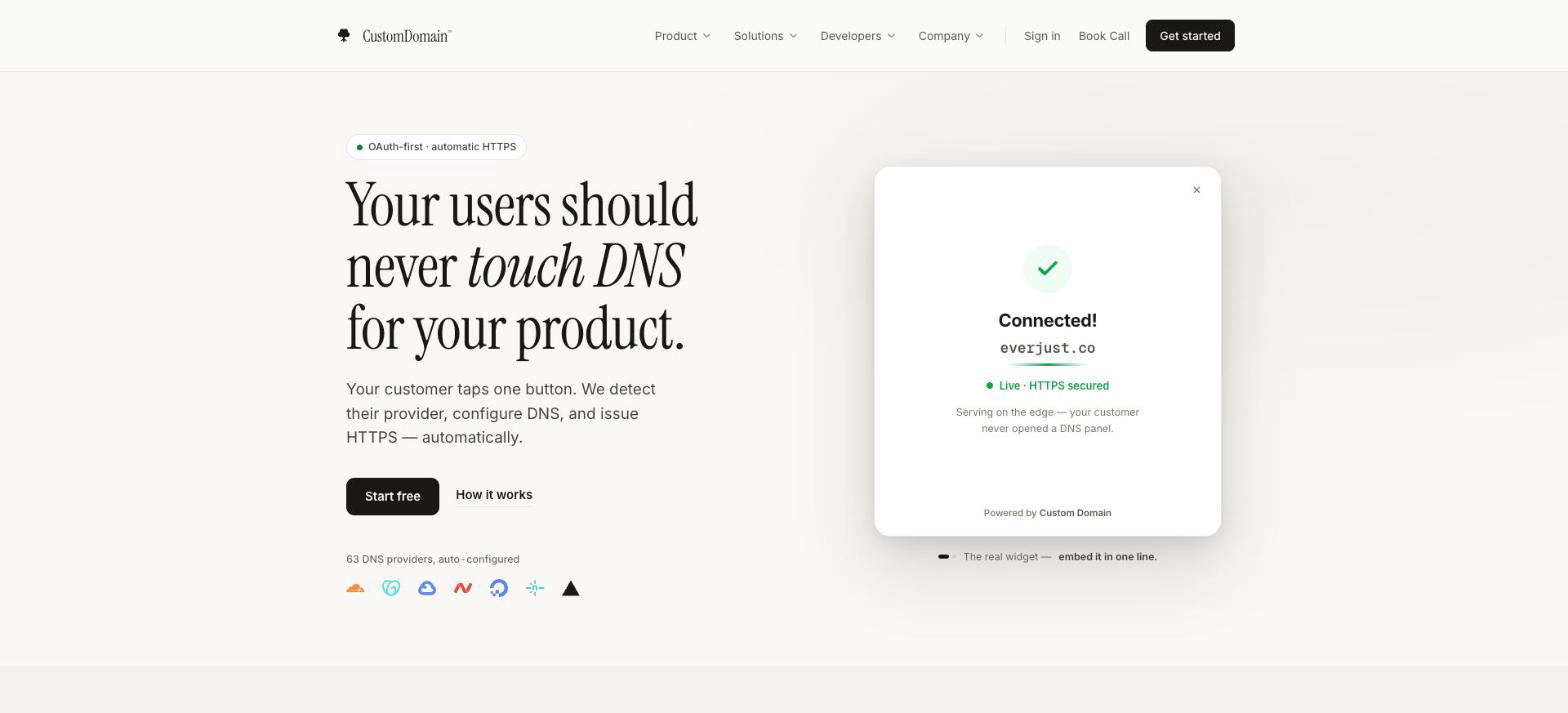
Custom Domain
OAuth-first DNS auto-configuration
Detects the customer's DNS provider and configures the records over OAuth across 63 providers, then serves the domain from its own edge. Priced in domain connections per YEAR rather than domains per month, which is the whole comparison.
| Feature | Domainee | Custom Domain |
|---|---|---|
| Free tier | 20 domains + 100 GB, forever | Yes (limited) |
| Monthly minimum | $0 | Free for 10 connections/yr |
| Per-domain pricing (monthly) | $0.20 → $0.10 (graduated) | — |
| Bandwidth pricing | 100 GB/month included · $0.05/GB after | — |
| Public REST API | Yes | Yes |
| MCP server (AI agents) | Yes | Yes |
| Self-serve signup | Yes | Yes |
Custom Domain pricing
Pulled from Custom Domain's pricing page. Your usage and contract may vary.
- 10 domain connections per year
- Connect DNS engine, REST API, webhooks, dashboard
- DNS drift detection included
- Blocked once the 10 are used
- 600 domain connections per year
- Not blocked past the allowance
- Everything in Starter
- 600 connections/yr plus overage in 1,000-domain blocks
- Reverse-proxy edge + automatic HTTPS listed here
- Overage block price is not published
- 12,000+ connections/yr, quoted
- Audit trail from Premium up
- White-label branding and domain resale on Enterprise only
Where Custom Domain is strong
- OAuth-based auto-configuration across 63 DNS providers, so the customer never opens a DNS panel
- Genuinely runs an edge and issues certificates on demand during the TLS handshake, rather than only configuring records
- Publishes an MCP server on every tier, including the free one
- DNS drift detection is included at every tier, not gated
- Flat tiers mean no metered surprise at the end of the month
Where Domainee pulls ahead
- Priced per connection per YEAR, so reconnecting a churned customer spends allowance again
- The free tier is 10 connections a year and hard-blocks at the limit (Domainee: 20 live domains, no block)
- The Growth overage block price is not published, so cost above ~1,600 domains needs a quote
- No published bandwidth allowance or overage rate at all
- White-label branding is Enterprise-only; audit trail starts at Premium
The big difference
Connections per year is a different unit than domains per month
Every tier is an annual allowance of connection events. Connect a customer, lose them, win them back, and you have spent three. It also means the published price stops describing your bill above roughly 1,600 domains, where Growth's unpublished 1,000-domain overage blocks take over. The pricing page's own enforcement table, which it says is taken from the plan catalog the API serves, has no row for the reverse-proxy edge at all, even though it appears as a Growth bullet, so which tiers serve traffic is not answerable from the pricing page.
Domainee's answer
Per live domain, per month, every rate published
Domainee bills for the domains that are actually live this month: 20 free forever, then $0.20 each with graduated volume discounts down to $0.10 above 10,000. Churn costs nothing to undo. Bandwidth is 100 GB a month included, then $0.05/GB, and all of it is on the pricing page rather than behind a call.
Ship custom domains for free.
20 domains and 100 GB bandwidth free, forever. No minimum. The only custom-domain API with first-class MCP support for AI agents.
The full walkthrough
customdomain.ai alternative in 2026: the unit is connections per year →